Esta semana uma nova versao do Waze, que considera a zona de Rodizio em Sao Paulo foi lançado. Sao Paulo é a primeia cidade no mundo onde esta funçao esta implementada.
Aparentemente esta implementaçao conta com algumas falhas, que provavelmente serao corrigidas rapidamente, mas que vale a pena comentar aqui:
Observação e alerta para os usuário do Waze em dia de Rodizio:
A Waze possui dois mecanismos para achar um caminho. Offline e Online. Mesmo sem obter contato com o servidor o Waze consegue achar um caminho pelo roteamento Offline.
Neste caso aparentemente sem considerar as informações do transito, mas somente o mapa básico ja carregado (Offline). Por isso que, as vezes, a janela de Buscando Rota aparece duas vezes, onde a segunda vez é resultado do contato com o servidor no modo Online. Isto na tentativa de acelerar a apresentação da primeira rota ao usuário para não entrar numa rota errada enquanto o app comunica com o servidor.
No caso de desviar da rota, o modo Offline indica rapidamente uma alternativa. Parece que a regra do Rodizio NAO esta carregada no mapa residente no app (Offline). Isto quer dizer que roteameno Offline NAO considera Rodizio! Isso quer dizer que um re-roteamento pode resultar numa rota que fere o Rodizio.
O Waze tambem possui um algoritmo de otimiçanao de rota, que durante a navegaçao aparece como uma janela verde anunciando uma rota mais rapida. Esta funçao, por enquando tambem NAO considera a area de Rodizio e no meu caso propoe melhorar o tempo em 35 minutos, mas furando com o Rodizio.
Imagino que isso vai ser corrigido mas proximas semanas. Enquando isso: Se o Waze fizer correçoes significativas para a sua rota, pede para refazer o roteamento pela lista dos últimos destinos que fica registra na lista dos destinos. Nao precisa cancelar a rota ativa, apenas responde sim para a pergunta sobre rota nova ou destino adicional.
Incomoda um pouco mas resolve por enquanto.
Thursday, August 13, 2015
Thursday, February 26, 2015
IT in a very competitive world
keeping all part of the body well-functioning. Studies from London Business School also show that for each 10 percentage points increase in the utilization of broadband connectivity, GDP is boosted with about 1,2%. ICT has now become ubiquitous, and takes an important role in the life of nearly all of us. One of the strongest evidences is the mobile phone, where companies like Google, Microsoft, and Apple are working on creating large eco-systems that can support us in nearly all aspects of life. In this way we can say that we are creating the Networked Society. This article will examine some clear indications of changes, and the impact on our economy at large.
First of all, the economy of the networked society is very efficient in generating value. In just one day, ICT and the Internet is generating USD 2,7 billion in ecommerce, 700.000 new Internet users, 133 million hours of YouTube watched, 328 million apps downloaded, and 2,7 billion photos taken. In 1990, the center of the US car industry with Chrysler, General Motors, and Ford, in Detroit employed 1,2 million people, had 1.600 billion in revenue, and was worth about USD 30 billion in market cap. In Silicon Valley today, Facebook, Apple, and Google are employing about 130.000 people with USD 1.400 billion in revenue, but has a total market cap of about USD 950 billion, with only 10% of the number of employees. The value creation and concentration in the ICT industry became clear to many this year, when Facebook acquired WhatsApp, a mobile messaging company founded in 2009, for about USD 18 billion. 2014 was also the year when Microsoft acquired the former highly estimated mobile phone business from Nokia for about USD 7 billion. WhatsApp, which prime product is a messaging application for mobile phones, was sold for more than two times the value of Nokia phones. The rationale behind that is based on the time that we spend on these services, and the information about our whereabouts has become highly valuated in the economy of the Networked Society. Facebook, with a market cap of about USD 200 billion, and 1,3 billion users, is worth USD 150 per user. WhatsApp, with about 500 million users was acquired for USD 36 per user, who in turn are more loyal than the Facebook users in some aspects.
One of the new paradigms about the Networked Society is that data is the new oil, and we are leaving trails and data about ourselves on the Internet sites and services where we spend our time. Most of this data is used to make marketing and advertising campaigns more accurate and relevant to consumers. Large brands are paying well to get in and have their advertising placed to consumers in the right moment of a buying decision. Where we spend our time, is where the large bands can reach us, and TV is becoming a winner at this game. In the 70’ies we spend in average 17 hours a week on TV. In 2013 that had increased to about 35 hour per week, and research shows that in about 4 years we will spend close to 50 hours on TV per week. This does not mean that we will sit in front of the big screen at home all that time, but as TV is transforming to YouTube, Tablets, and mobile devices, we are watching more and more TV on these devices, inside or outside our homes. Research from the UK ICT regulator Ofcom released in August 2014, shows what the Brits in average are now spending more time on media and communication than on sleeping. 8 hours and 41 minutes of media and communication, against 8 hours and 21 minutes of sleep, and only 6 hours and 58 minutes with activities not involving media. The same survey also reveals that adults above 16 years spend in average the same time on a traditional TV set as they spend in Smartphones and Laptops, whereas the young segment from 16 to 24 years spend 2,5 times as much time on their Smartphones and laptops compared to a TV set, namely 515 minutes per day (fig1).
These ICT trends are also having significant impact on the Brazilian economy. The Brazilian ICT industry is well developed, and getting mature as Internet and communication services are now connecting a very large part of the population. Telebrasil, the association of telecommunication operators in Brazil, released in July their consolidated numbers showing that Brazil now counts 161 million broadband connections. A 51% increase over the last 12 months. Of these, mobile broadband on 3G and 4G connections corresponded to 85%, namely 138 million connections. A 61% increase compared to same time last year. 119 cities in total, and 45 cities with more than half a million inhabitants have 4G coverage today, and 3.730 municipalities corresponding to 92% of the national population have 3G coverage. In July, the telecommunication statistics site, Teleco, reports 276 million mobile subscriptions. This means that Brazil now counts with a penetration of mobile telephony of 136% measured on number of subscriptions. In comparison Denmark has a penetration of 150% and USA 106%. The penetration of smartphone use is also beginning to take off well in Brazil, where nearly 30% of phones today are smartphones, compared to about 60% in Denmark and USA. This fast maturation of the Brazilian ICT industry has contributed well to growth in the sector over the last few years. According to the association of the Brazilian ICT industry, Brasscom, Brazil was in 2010 ranking as number 6 in the list of the largest ICT economies, and has advanced two positions to number 4 in 2012 passing UK and Germany, and the size of the industry in 2012 was about USD 160 billion. The industry has yet to increase its export. In 2012 the country exported USD 526 million of software, and USD 1,33 in ICT services.
ICT is important for the socio-economic development in Brazil for the years to come. ICT is a driver for Economic development through job creation, leap in competitiveness and productivity, and the development of small and medium size companies. In Rio in 2011 the company Easy Taxi was started by a local entrepreneur Tallis Gomes. The application helps people to quickly find a free taxi, and works in smartphones. As many of the disruptions in the ICT industry, it adds value to both the sector and its clients. Customers receive information about car license plate, phone number and ID of the driver, already before the taxi arrives. If you lose something, you just call the taxi driver right away. The business model cuts out the costly taxi cooperatives, and gives a better business flow for the driver, who can now also receive payments and issue receipts through the app. Only the taxi cooperatives may not be happy as they are cut out of business, but that is part of the efficiency that the ICT creates, where gatekeepers and intermediate links are eliminated. Easy Taxi has with capital injections of USD 32 million been able to expand to many Brazilian cities, and is now also available in 80 cities in 27 countries adding three cities per month. Easy Taxi is currently evaluated at USD 100 million in market value by worldstartupwiki.org. Talking about traffic, the municipality in Sao Paulo calculated that traffic congestion is responsible for the loss of BRL 40 billions per year in the city alone. According to Globo.com, apps like Waze, a smartphone based social GPS application sharing traffic information among its users, which were used by more than 6 million Brazilians already in 2013, can save 20% or more in driving time, corresponding to a gain of BRL 8 billion. ICT is also important for social development. Both the education and health sectors see great benefits of ICT. These are sectors that are essential for the development of Brazil going forward. High productivity is reached through education and innovation, and here Brazil has a chance to leapfrog with the introduction of ICT. The distance teaching division, EAD, part of SENAC, estimates that 25% of courses in higher education in Brazil today are done as distance teaching, and that this market will double in 5 years. The market is expanding with 12% per year against 4% for normal education. ICT can help to cut the prices of the courses with up to 75%. This means that now most Brazilians, no matter where they live in the country, can get access to higher quality of education, and we will surely see the results of that in the coming years. A leading institution in distance learning in Brazil, Universidade Norte do Pará, was sold to Kroton Educacional for BRL 1,3 billion in 2011, so there are already significant investments in developing ICT based education in Brazil. It should be clear to the management of any business that ICT is a significant contributor to efficiency and hence to growth. Governments from national to municipal level are placing ICT high on the priority list for
accelerating development. The Brazilian government has launched an ICT development program called TI Maior, with a budget of BRL 500 million until 2015, of which BRl 40 million is reserved to boost new startups through the program Startup Brasil. Many municipalities are also setting up technology development centers, and according to Brasscom, Brazil has 40 of these centers today spread all over the country. In order to describe the gain and advance of ICT in multiple sectors in cities around the world, Ericsson, a leading telecommunication infrastructure vendor, created a Networked Society City index 2013, that ranks cities according to the ICT maturity (fig2), and the sustainable triple bottom-line benefit that the city reports. Placed at number 17, Sao Paulo is the highest ranked among the evaluated cities from Latin America, in front of Buenos Aires, and Mexico City. Copenhagen is number 5 after Stockholm, London, Singapore, and Paris.
This article was written for Brazilian Review 2014
Sunday, February 22, 2015
Our digital lifestyle. Reloaded onto hardware.
Hardware is becoming more important in shaping the future of our digital life.
During the last decade, and especially since the iPhone was launched in 2007 there has been a strong focus on Digital would change our life, and most of it concentrated around software and apps. Just look at the price tags in acquisition of software companies.
This is now changing.
If you now look at the latest quarterly result of Apple, and how they derive value from selling hardware and its clear that there something to come for, but look also at the deals in the robotics area that Google are doing, and the projects of Elon Musk.
The power of change that Digital and Software have shown us are now taking physical shape as
robots and drones, and 3D printing is also a strong driver for this. Self-driving cars, as portrayed a couple of times on this page is one instance of this mega trend, and lately the date at which these cars will take to the streets seem to be moving closer as more companies invest seriously. Just check out Google, Mercedes, Volvo, and Uber.
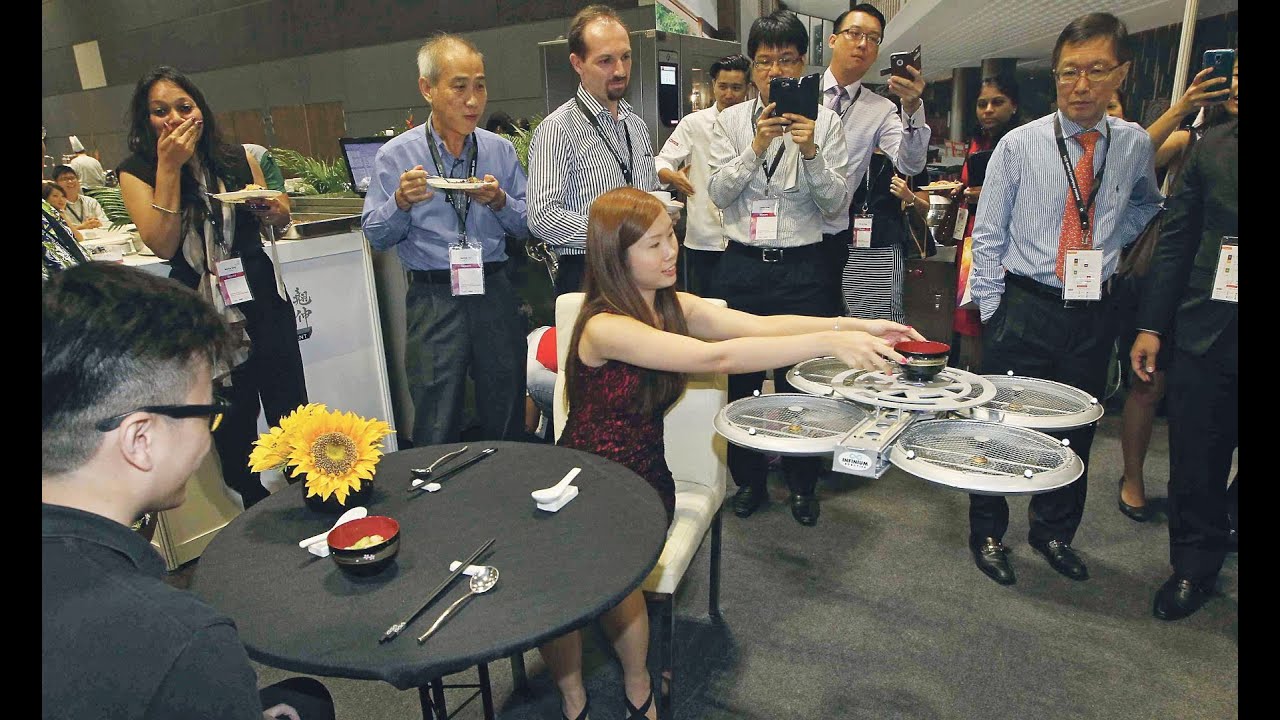
Lately drones has been moving indoor: This year, the restaurant Timbre in Singapore will launch drones serving dinner at your table. Perhaps not the most romantic atmosphere, but make no mistake. In most ambients there are more cubic meters than square meters, and that space will be used in the future. Aalborg University in Denmark has also engaged in a partnership to develop the future for indoor drones.
Get ready for Digital reloaded... onto hardware.
Wednesday, December 17, 2014
The WhatsApp aquisition: Does it make sense in the aftermath?
Let's put this in a broader perspective.
Imagine 10 years ago if you were called in by a group of executives wanting to know about disruptive business models 10 years ahead.
You would tell them that in 2014, a company that does not exist in 2004, nor does it's business model exist, will acquire another company with 55 employees, which prime product is an application which can send messages among mobile phones , and the price of the acquisition will be 2.5 times the price at which Nokia is acquired by Microsoft the same year.
I am very sure that your audience would thank you for your prediction, but most likely none of them would believe you. Perhaps even more if you told them the size of the price tag.
So, like in many other cases, reality beats fantasy. The fact remains that earlier this year Facebook acquired WhatsApp for $19 billion. This is the second largest technology acquisition in history, after the HP acquisition of Compaq in 2001 for $25 billion.
Many would say that Facebook today is the world's largest communication company with close to 1.4 billion users, offering anything from voice communication over messaging to sharing of photos and download of applications.
When we compare many of the high profile acquisitions of Internet stars over the last decade, it becomes apparent that WhatsApp is standing out compared with the others. After four years WhatsApp had reached 419 million users compared to Facebook, which reached 145 million users in the same amount of time since it was launched. Twitter and Skype had reached roughly 50 million users in the same period since they were launched. Since the acquisition WhatsApp has continued to grow and reportedly reached 600 million users in August 2014, which represents an accelerated growth lately.
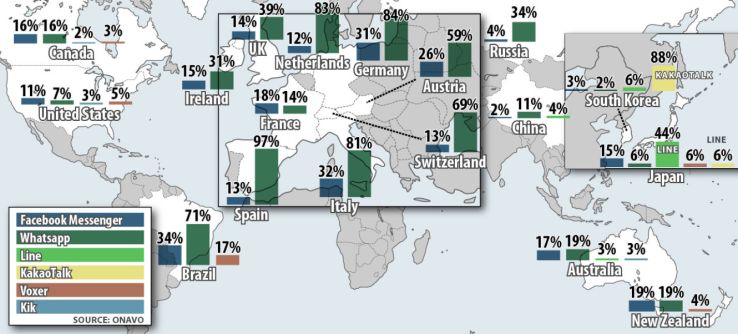
One of the things that strikes the eye when looking at the service penetration of messaging applications worldwide is that there are large differences among different countries. In countries like the United States, Canada, France and Australia Facebook Messenger seem to have to comparable penetration to WhatsApp of about 11% to 17% of mobile Internet users. In many European countries including Germany, Italy, Spain, and the Netherlands WhatsApp enjoys penetrations of 80% to 90% with Facebook Messenger on about 1/3 of the penetration in the same countries. Brazil is outstanding as a country where Facebook Messenger has a relatively high penetration of 34%, and where WhatsApp has an even higher penetration with 71% of the mobile Internet users. In any case, it becomes very clear that WhatsApp brings a lot of new messaging users to Facebook that it's Messenger app didn't reach before.
When Facebook acquired WhatsApp it had approximately 450 million users, and it has grown to 600 million users since. Not only does the number of users impress, but also the frequency by which these users actually use the app. WhatsApp enjoys a rate of 70% of its users being active on a daily basis compared to Facebook Messenger which has about 61%. This should be compared to the industry standard which is between 10% to 22% of the users.
So, at $19 billion at the time of the acquisition each WhatsApp customer was worth about $40 per user. When Facebook launched it's IPO in 2012 it was worth about $125 per user. Today, with about 1.35 billion users and a market cap of $208 billion, the company is worth $154 per user. So measured by the number of users and their level of activity it seems that the price tag of WhatsApp was reasonable. Data is the new oil, and so WhatsApp will unquestionably have access to data about content and communication that people share to an extent that was not a accessible to Facebook before the acquisition. It is however a very difficult to estimate the value of this information, but the concerns lately on privacy on the Internet could have provoked a migration to communication in smaller and more closed groups, and Facebook might have secured a significant access to the data from this type of communication going forward with this deal.
When you start to look into some of the operational metrics of WhatsApp, some remarkable numbers begin to appear: With 450 million users and only 32 engineers, it means that each engineer was serving 14 million users. This measure is quite unique compared to any other company offering software to serve its customers. It is also a remarkable to note that WhatsApp hasn't spent nothing on marketing until today. The application was spread only by a viral channels. Apparently, the company does not even have marketing or PR staff.
But there also are also other types of rationale behind the acquisition that could be interesting to look at. WhatsApp until today, does only work on mobile phones. As part of the authentication process WhatsApp will verify your phone number. This means that WhatsApp has information on the valid cellphone number of all its users. This is an information that many other application developers is trying to get from people. However, lately there has been rumors that WhatsApp might be developing a Web version. We can only speculate as to how they will do the authentication of the user's identity, but one option would be to pair the user registration with an authentication through a mobile phone.
Some analysts point to research showing that users are turning away from Facebook Messenger to other instant messaging applications such as watchApp and WeChat. It is possible that the Facebook management had seen this trends very early, and wanted to make sure our that nobody else would pick up WhatsApp. There are reports that Google was interested in acquiring the company and had offered a price tag of $10 billion. Now, according to some reports Facebook Messenger has suffered a decline from 512 million users in the first quarter of 2013 to 313 million users in third quarter 2014.
Finally, it also seem that Software based Internet companies have more appetite on large acquisitions compared to hardware based Internet companies. When comparing the acquisitions made by Facebook, Amazon, Google and Apple it appears that Facebook and Google have made much larger acquisitions over time compared to the other two.
Monday, March 31, 2014
DNA lego is now freeware. Have your DNA string sent by mail
with this interest.
Technology is developing fast, and my resent post on how virus is sequenced, and thereby converted into a written code which can be interchanged via email among scientists, and be converted back into a living virus, has now been surpassed, and building up own DNA code is now within reach of anyone who has this interest... and its freeware...
So what do you do with your newly developed DNA string? You could send it to Cambrian Gemonics, which can print your DNA string with a new laser printing technology and sent it to you.
So far, this can be done for relatively simple life forms, and not on human beings, my guess is that before we have been able to discuss and decide on the ethics for using this on humans, it is already reality. In a future post we can discuss the beneficial and security aspects of it.
Thursday, October 31, 2013
Biological Virus can now spread via email.
When the first computer viruses began to emerge in early 1970'ties, I thought the name was a great analogy to the biological counterparts, but I was also happy that these digital self-reproducing elements where not able to infect my physical body. Unfortunately, these happy days may soon be over.
In a resent article in the magazine Foreign Affairs the term "Germs 2.0: the first self-replicating bacteria made in a lab" is used to introduce us to the fact that we can make and replicate artificial virus and bacteria, which in turn can replicate itself. According to the article, it seem that we need to get used to the fact that we can "start in the computer in the digital world from digitized biology, and make new DNA constructs for very specific purposes".
Simply put, we can change the printer head from a 3D-printer which normally uses plastic as printing material to printing with nucleotides, and thus making self-reproducing biological beings. The article describes how J. Craig Venter, an American biologist and entrepreneur, is able to produce a virus with a printer in 12 hours from an e-mail. Today this is used to make virus for vaccine production. Venter talks about this in a lecture at the Trinity College Dublin.
Another article in Council on Foreign Relations speculates on how this might influence on global security policies. It seem that cyber-warfare can very fast transform in to biological warfare. The article describes how "the Animal Influenza Lab of China's Harbin Veterinary Research Institute used new biology techniques in 2013 to manufacture 127 previously nonexistent types of influenza viruses, five of which spread through the air between guinea pigs". We can now ask ourselves: What is worst, to spread these 127 viruses by simply letting them into the air, or by email over the Internet?
So, as DNA synthesis and production of living organisms seem to be connected to the digital world, we can perhaps expect that future computer programs, good or bad, can reproduce themselves as living creatures. Today, it seem that comparing this outlook with the Terminator movies and Skynet taking over the world with mechanical robots was just another proof that reality beats fantasy by far...
Wednesday, October 9, 2013
In 2007, when the iPhone came out Nokia seemed unbeatable to most of us. Does Facebook have a weak spot also?
recently Nokia, and why not look at some of the companies that are still at their peak such as Apple, Google, and Facebook?
I will not spend much space here on Apple. Mostly because the fate of the company does seem to owe a lot to its CEO, and therefore has less to do with how it responds as a company culture to global digital trends. As I see it, since Steve Jobs passed away, the company has been fine-tuning itself as a profit engine more than a innovation engine. No new ground braking innovations, but a lot of focus on improving the figures, and increasing hardware performance with new processors and other new parts inserted into the already well-known product line. This shift seem to reflect the profile of the current CEO Tim Cook.
During a series of visits by my good friend Jeffrey Cole from the Center for the Digital Future in California, we talked, and made some public sessions with executive round-tables. I would like to share two here:
During the sessions we talked frequently about Facebook, and Jeff made a comment which I often mention when people talk about the future of Facebook.
Its just like when a new hot disco inaugurates in town. Everybody wants to go there, but after some time people will move on and try out other new venues and concepts. Admittedly, Facebook has been trying to do a lot, including acquiring other popular sites to keep ahead, but can it keep up the pace? It seem that a number of more context related social media are coming up, but let's save that for another post.
Anyway, one of the worst thing that can happen to teenagers in the hottest disco, is that their parents or grandparents turn up, and this is exactly what is happening to Facebook. So, this morning I saw this post: "I'm so over Facebook", and some of the quotes really stroke me:
- Ruby's parents embarrass her with "Hello Sweetie pie" posts on her wall while her friends post photos that get her into trouble with the parents.
Bang... Right there. Facebook is becoming old-school, and new teenagers see Facebook as something their parents and older peers are using. Its like trying to mix water and oil. You can stir it up, but at some time it will separate. Em medium time range, it seem to me that Facebook will continue in parallel with other social media. Probably smaller than today though.
On Google, there are no really good hints on the company's fate, except a comment Jeff made one day:
- If someone comes up with a bright new search algorithm, like real semantic search, they can be out of business in three months.
Maybe they have seen this, as they do invest in a number of other activities besides their search algorithm.
We better get used to it. Nothing is forever, except tax bills...
Wednesday, January 9, 2013
The Brazilian IT development in a global context.
The investment in Information Technology is becoming a strategic factor in innovation and national development, and governments in all parts of the world are considering how to use IT to boost productivity and growth.
Companies IT and efficiency.
In times of crises, competitive position and productivity becomes even more important. From cases in several countries it can be shown that there is a connection between the investment in IT and GDP growth. An EU report from 2003 compared data from USA from 1995 to 2001, and found that sectors with high investment level in IT had an average growth of 3,5% against a negative average growth on -0,5% in sectors that did not invest in IT.
Lately companies are subject to so called consumerization, where the IT service and infrastructure is strongly influenced by the Web services and devices that we as as normal consumers have assess to with large mail boxes and sophisticated mail tools. The large consumer driven Web companies; Apple, Amazon, Google, and Facebook are all investing heavily in making their services mobile and available to users of smartphones, which today have a performance comparable with laptop computers. Today's employees bring this consumer experience with them to the companies they work for, and they expect that their workspace have the same convenient services. Many employees are disappointed with conventional mobile phones, or expect their employers to offer devices with the same operating systems and features. The trend is that companies today are beginning to allow their employees to use their own mobile devices to access the company's network services. More employees also accept to pay for and bring their own device, or the employer can choose to pay a certain amount to each employee to buy their preferred devices. This tends has its own term: Bring Your Own Device or BYOD, and is one of the drivers for IT investment. If companies adopt the right strategy, they can both manage to control cost for investment in devices to mobilize their employees, and becoming more efficient at the same time, as their workforce can accomplish their assignments at anytime anywhere.
Clouds are already part of our lives.
As mentioned, mobility is an important feature of today's web services, and the success of the these services depend heavily on the presence of good mobile broadband connectivity. This is because many of the applications and services offered today are build on cloud infrastructure. Cloud as a concept does not make sense to most people, but many popular services are already build on cloud infrastructure. Mail services like Gmail, Hotmail, and many others are cloud-based in the sense that they are hosted somewhere out on the Internet, and can be accessed at anytime and anywhere, especially when we start to use our mobile phones. Years back, we used to download our emails to our desktop or laptop computers, and the mail where deleted from the central server. This meant that we could risk loosing all our email correspondence if the computer broke down, or when migrating to a newer computer. Most service offered from the large Internet companies already mentioned are based on this cloud concept, and IT, Web, and Telecom Services are rapidly converting into one market through these synergies.
Market status.
Mobile broadband is growing rapidly in Brazil and in October 83 million broadband connections where recorded. This corresponds to a 58% growth over the last 12 months. 63 million of these broadband connection were mobile, and they grew 81% over the last year.
Today, the Brazilian IT market is the 6th largest in the world with a size of $112 bn in 2011, representing a 13% growth compared to 2010, and corresponding to 4,5% of the Brazilian Gross Domestic Product (GDP). The telecom market represented an addition volume of $100 bn in 2011. The latest estimate for the Brazilian IT market in 2012 issued by Brasscom - the Brazilian association of IT companies, is forecasting a growth of 14%. The Brazilian IT sector does relatively little export with only $2,65 bn for 2011 corresponding to only 2,3% of the total. Most of this export is software, as Brazilian manufacturing has yet to achieve a competitive level compared to the global market.
The slowdown of the growth in the Brazilian economy, and the increase in consumer dept is expected to influence in the development of the Brazilian IT market for 2013 with a weaker trend.
It is often discussed whether the investment in IT can help countries grow. The McKinsey Global institute has released a survey showing that the Internet contributes to 21% of the GDP growth in developed countries, compared to an average of 3% for the BRIC countries in the period from 2004 to 2009. This should be matched with the report from Eurostat 2010 revealing that for each job position opened in the IT sector in India, another 3,6 positions are opened in other sectors. These are two good reasons to invest in the IT sector.
The Brazilian Government is giving incentives to make the IT and Telecom industries help the country to grow.
It is widely accepted that investments in the IT and Telecoms industry spur growth in other sectors. The Brazilian government is implementing this vision through the re-construction of Telebras and the voting of Provisional Measure MP 563 to accelerate infrastructure investment, with the right to issue tax-free bonds for special purpose infrastructure projects, which is now attracting more foreign investments to the country. As slow as the growth outlook might be for the moment, the IT investments will help the GDP growth for the coming years.
(I wrote this article for the Danish-Brazilian Chamber of Commerce magazine "Brazilian Review" issued earlier this month)
In times of crises, competitive position and productivity becomes even more important. From cases in several countries it can be shown that there is a connection between the investment in IT and GDP growth. An EU report from 2003 compared data from USA from 1995 to 2001, and found that sectors with high investment level in IT had an average growth of 3,5% against a negative average growth on -0,5% in sectors that did not invest in IT.
Lately companies are subject to so called consumerization, where the IT service and infrastructure is strongly influenced by the Web services and devices that we as as normal consumers have assess to with large mail boxes and sophisticated mail tools. The large consumer driven Web companies; Apple, Amazon, Google, and Facebook are all investing heavily in making their services mobile and available to users of smartphones, which today have a performance comparable with laptop computers. Today's employees bring this consumer experience with them to the companies they work for, and they expect that their workspace have the same convenient services. Many employees are disappointed with conventional mobile phones, or expect their employers to offer devices with the same operating systems and features. The trend is that companies today are beginning to allow their employees to use their own mobile devices to access the company's network services. More employees also accept to pay for and bring their own device, or the employer can choose to pay a certain amount to each employee to buy their preferred devices. This tends has its own term: Bring Your Own Device or BYOD, and is one of the drivers for IT investment. If companies adopt the right strategy, they can both manage to control cost for investment in devices to mobilize their employees, and becoming more efficient at the same time, as their workforce can accomplish their assignments at anytime anywhere.
Clouds are already part of our lives.
As mentioned, mobility is an important feature of today's web services, and the success of the these services depend heavily on the presence of good mobile broadband connectivity. This is because many of the applications and services offered today are build on cloud infrastructure. Cloud as a concept does not make sense to most people, but many popular services are already build on cloud infrastructure. Mail services like Gmail, Hotmail, and many others are cloud-based in the sense that they are hosted somewhere out on the Internet, and can be accessed at anytime and anywhere, especially when we start to use our mobile phones. Years back, we used to download our emails to our desktop or laptop computers, and the mail where deleted from the central server. This meant that we could risk loosing all our email correspondence if the computer broke down, or when migrating to a newer computer. Most service offered from the large Internet companies already mentioned are based on this cloud concept, and IT, Web, and Telecom Services are rapidly converting into one market through these synergies.
Market status.
Mobile broadband is growing rapidly in Brazil and in October 83 million broadband connections where recorded. This corresponds to a 58% growth over the last 12 months. 63 million of these broadband connection were mobile, and they grew 81% over the last year.
Today, the Brazilian IT market is the 6th largest in the world with a size of $112 bn in 2011, representing a 13% growth compared to 2010, and corresponding to 4,5% of the Brazilian Gross Domestic Product (GDP). The telecom market represented an addition volume of $100 bn in 2011. The latest estimate for the Brazilian IT market in 2012 issued by Brasscom - the Brazilian association of IT companies, is forecasting a growth of 14%. The Brazilian IT sector does relatively little export with only $2,65 bn for 2011 corresponding to only 2,3% of the total. Most of this export is software, as Brazilian manufacturing has yet to achieve a competitive level compared to the global market.
The slowdown of the growth in the Brazilian economy, and the increase in consumer dept is expected to influence in the development of the Brazilian IT market for 2013 with a weaker trend.
It is often discussed whether the investment in IT can help countries grow. The McKinsey Global institute has released a survey showing that the Internet contributes to 21% of the GDP growth in developed countries, compared to an average of 3% for the BRIC countries in the period from 2004 to 2009. This should be matched with the report from Eurostat 2010 revealing that for each job position opened in the IT sector in India, another 3,6 positions are opened in other sectors. These are two good reasons to invest in the IT sector.
The Brazilian Government is giving incentives to make the IT and Telecom industries help the country to grow.
It is widely accepted that investments in the IT and Telecoms industry spur growth in other sectors. The Brazilian government is implementing this vision through the re-construction of Telebras and the voting of Provisional Measure MP 563 to accelerate infrastructure investment, with the right to issue tax-free bonds for special purpose infrastructure projects, which is now attracting more foreign investments to the country. As slow as the growth outlook might be for the moment, the IT investments will help the GDP growth for the coming years.
(I wrote this article for the Danish-Brazilian Chamber of Commerce magazine "Brazilian Review" issued earlier this month)
Thursday, January 3, 2013
Apple looking for Waze to solve the mapping issue
Funny that I should write a post about Waze, and the news would brake a few days after that Apple is looking towards Waze as a possible way out of the mapping issue they got into after shredding Google Maps as a pre-loaded app for the iDevices.
Sunday, December 23, 2012
Social GPS navigation. A good way to find your Waze... .
| See other drivers and the event which they add in real time |
I have always been a great fan of Google Maps, and was a bit suspicious about trying out a new GPS app. My conclusion is that each app has justified their right to live side-by-side on my phone screen, and here is why.
Waze is a real-time community app allowing users to communicate in a very simple way about the events they observe in traffic. Yesterday, I drove seven hours from São Paulo to Teresópolis in the state of Rio, and unlike most people who take the Ayrton Senna (BR-070) I chose the parallel Dutra (BR-060) highway. Google maps helped me to make the right decision as the Ayrton Senna was heavily congested on a section of about 10 km. The precise colored traffic information on Google Maps is always a great help to me when driving through the yet few cities in Brazil that are covered with this great feature which show traffic congestions with accuracy down to 100 meters. Waze, on the other hand, give the opportunity for users to communicate in real time about accidents, police check points, bad weather, heavy traffic, gas prices, obstacles, and other hazards on or by the road. You can also sign up to one of the groups on Waze and share traffic information with others from your work, street, or city.
| Check out gas prices on a gas station near you |
When I left the São Paulo urban area and drove into the Brazilian hinterlands I left the Google Traffic overage area, and found that the Waze app offered a great value add by giving me a good overview of the traffic. I got alerts on heavy rain, accidents, slow traffic, and some of them even with detailed comments from others on what had happened and the consequences for drivers.
So when traffic comes to a stand-still, things are now less tedious with Waze as you can now get information on what is ahead, and even chat with others in the traffic while the car is stopped, which those of us living in São Paulo are quite used to. I guess it won't be long until we hear about the first couple who met in a traffic jam.
Google Latitude, a once separate app now included as a function within Google Maps, never seemed to get me as a regular user on sharing my position, but Waze seems to be easier and more convenient to use if you momentarily want to share the progress on your route towards your destination. The Meet Up tab offers you to share your current location, share your progress en route, and to request a pick-up with one of your friends on Waze. The function is disconnected when you reach your destination or otherwise stop your navigation towards that point, which should attend most privacy concerns.
| Send SMS or email so other can follow you en route to your destination. |
Based on the increasing problems with traffic jamming up in cities around the world, there should be a good basis for a growing audience to this application. Going social in traffic seems as a great idea, if we just remember to keep attention on the road, but Waze will help you remember that by the way it's build. I look forward to testing it in the US or Europe in a not too distant future.
Friday, December 21, 2012
Time for a new Nexus phone?
![]() |
| Nexus 3 (Samsung) |
I am very happy about the phone, and things was going just well until two weeks ago when I discovered that the auto-focus on the main camera was suddenly un-functional. I can take close-ups, but a landscape picture looks like the one shown here. If I hand in the phone to a repair shop, I will have to live without it for weeks, that seem unbearable.
Meanwhile, a new Nexus came out. The LG Nexus 4, this time made by LG, also called the E 960. Google seem to release one every year. I like the Google phones because they have no handset manufacturer OS overlay to Android, and I am the first one to receive the latest updates of the Android OS, and this phone already runs Android 4.2 Jelly Bean.
![]() |
| Nexus 3 Picture without auto- focus |
So, should I buy the Nexus 4 and repair my Nexus 3, and sell it? Well, the jury is still out on this one, but tell me your opinion, and I will make a choice first in the new year.
![]() |
| Nexus 4 (LG) |
Sunday, November 11, 2012
The Web is now designed to judge your intentions ... and so are the terror conventions.
In both marketing and some definition of crime, what really counts are your intentions.
In several of my presentations on the Digital Footprints that we leave behind us on the Web, I have highlighted the changes in the definition of committing a crime. The film - Minority Report - presented us with the vision of condemning individuals based on their intention or imagination of committing a crime, even if in their dreams. This vision is becoming reality faster than many of us would imagine.
The terror conventions are in the forefront when it comes to defining a crime as the intention to harm people or property. "Criminal acts intended or calculated to provoke a state of terror in the general public (...)" United Nations, December 9, 1994, UN Doc. A/Res/60/49. This still leave it unclear wether you must have committed the act in order to be considered a terrorist, but we already know that many terrorists are arrested before they commit the intented attack. Looking at the Counter-Terror Social Network Analysis and Intent Recognition (CT-SNAIR) project, the Web component of the prediction of ill-intented individuals becomes more clear.
The interesting match here is that both the terror definition and the lawful and well indented use of the Web for marketing purposes result in the interest in identifying and segmenting the intention or interest of people or groups of people . In the case of terror, you can rightfully say that it makes little sense to claim that a suicide bomber should commit his planned crime before he or she can be arrested and sentenced.
As a very successful advertising and segmentation company, Google knows a lot about our intentions, and former Google CEO Eric Schmidt once said that Google wants to present the answer to us even before we put the question. This makes Google and other Web marketing and search companies interesting for certain type of crime prediction. According to Wikipedia, the Brazilian government topped the list of governments requesting information on citizens from Google between June and December 2009 with 3.663 requests against 3.580 from the US government. The article from Wikipedia also mention possible links to the CIA and NSA, and the US magazine Wired brought earlier this year an article on the logging of much of what we do on the Web.
A similar consideration came up last week during a trial in Denmark where 5 men are accused of committing acts of terrorism. The Danish newspaper Ekstrabladet reports that one of the accused allegedly made a search on his computer on the location and about the attack before the story had been reported by the media. He is now accused of having committed the attack where his Web search pattern is part of the evidence presented to the judge.
So, be aware. Your intentions might frame you. And the systems made for predicting your intent as a consumer, might be tweaked to screen you out as possible ill-intented person or even considered a criminal. Even before you become aware of it, as Google say...
In several of my presentations on the Digital Footprints that we leave behind us on the Web, I have highlighted the changes in the definition of committing a crime. The film - Minority Report - presented us with the vision of condemning individuals based on their intention or imagination of committing a crime, even if in their dreams. This vision is becoming reality faster than many of us would imagine.
The terror conventions are in the forefront when it comes to defining a crime as the intention to harm people or property. "Criminal acts intended or calculated to provoke a state of terror in the general public (...)" United Nations, December 9, 1994, UN Doc. A/Res/60/49. This still leave it unclear wether you must have committed the act in order to be considered a terrorist, but we already know that many terrorists are arrested before they commit the intented attack. Looking at the Counter-Terror Social Network Analysis and Intent Recognition (CT-SNAIR) project, the Web component of the prediction of ill-intented individuals becomes more clear.
The interesting match here is that both the terror definition and the lawful and well indented use of the Web for marketing purposes result in the interest in identifying and segmenting the intention or interest of people or groups of people . In the case of terror, you can rightfully say that it makes little sense to claim that a suicide bomber should commit his planned crime before he or she can be arrested and sentenced.
As a very successful advertising and segmentation company, Google knows a lot about our intentions, and former Google CEO Eric Schmidt once said that Google wants to present the answer to us even before we put the question. This makes Google and other Web marketing and search companies interesting for certain type of crime prediction. According to Wikipedia, the Brazilian government topped the list of governments requesting information on citizens from Google between June and December 2009 with 3.663 requests against 3.580 from the US government. The article from Wikipedia also mention possible links to the CIA and NSA, and the US magazine Wired brought earlier this year an article on the logging of much of what we do on the Web.
A similar consideration came up last week during a trial in Denmark where 5 men are accused of committing acts of terrorism. The Danish newspaper Ekstrabladet reports that one of the accused allegedly made a search on his computer on the location and about the attack before the story had been reported by the media. He is now accused of having committed the attack where his Web search pattern is part of the evidence presented to the judge.
So, be aware. Your intentions might frame you. And the systems made for predicting your intent as a consumer, might be tweaked to screen you out as possible ill-intented person or even considered a criminal. Even before you become aware of it, as Google say...
Friday, March 23, 2012
Will Wi-Fi off-load save us?
So Wi-Fi off-load seem to be the savour of our times.
It is very interesting to note that with hundreds of megabyte of spectrum sold to the mobile operators, it is apparently the un-licensed general purpose spectrum in 2,4 GHz and 5 GHz which is going to be the solutions to the ever growing data volumes that operators are trying to coupe with.
I got curious and read trough 5 reports from well estimated suppliers of industry analysis about Wi-Fi off-load, and none of them talks anything about the outlook for the scenario where all private and public Internet connectivity providers seem to be heading for the same crowded street. My feeling tells me that we are heading for congestion.
In licensed spectrum operators do their own radio cell planning, because they know that others are not allowed to interfere with the transmission that they provide. In the un-licensed frequency bands however, everybody seem to be doing their own planning for the same spectrum.
Some global operators have informed that up to 70% of their current fixed and mobile broadband data volumes are now being transmitted via Wi-Fi at some point, and the above named industry analysts estimate that mobile operators will be off-loading at least 40% of their traffic in 3-5 years.
It is good to see that the Brazilian regulator, ANATEL, has taken initiative to establish targets and measurement for the quality of broadband services in Brazil, where some operators are being criticized for delivering much less than what their customers are paying them for in terms of bandwidth and availability. On the other hand it is difficult to understand how operators can guarantee the quality of a service when depending on shared spectrum where there is no entity responsible for the planning and utilization of the spectrum, other than the general purpose certification of the transmission equipment required by ANATEL. One of the consequences is that when I go to a downtown restaurant to try to get on a Wi-Fi network toady, I get a long list of networks all struggling for the same spectrum, as you can see on the enclosed picture. There are also several reports where people get lower performance of the their installed Wi-FI at home when the public and operator driven Wi-Fi networks begin to transmit on the same channels used for the home solutions.
Maybe one of the reasons for this increased interest in the un-licensed frequency bands is coming up now because operators and other industry players are realizing that with the current growth in data volumes, there is no other way out than to go for smaller cells. There is no way that each user can seize a transmission channel in an area of a square kilometer or more when spectrum is a scarce resource. It seems that the vendors of cellular technologies (CDMA and GSM), moving on with 3G and 4G, have not been too keen on developing equipment for these small cells, and that operators now see a change to get acquainted with low cost technologies that that serve the need for smaller cells. The trade-off, however, seem to be that everybody will deploy in the same limited spectrum with little or no coordination between the players.
If you have an Android phone, you can download the Wi-Fi-analyzer shown here at the picture, and check out if the Wi-Fi frequencies near you are congested.
Ericsson's acquisition of Belair should also be seen in this light. Ericsson has lately decided to accelerate its strategy for small cells. It would however, only be natural that both the small cell strategy and technologies with the same cost level as for Wi-FI would spread into the licenced bands also, using LTE for example. This might not be in all of the current cellular tech providers interest, but it would make sense from two points of view. Small cells give higher data traffic densities in any frequency, and thus also for the licenced spectrum, and LTE 4G is the latest set of very robust cellular coverage technologies with great resistance to interference and made for continuous coverage.
There is no doubt that Wi-Fi is gaining importance, and with up to 90% of tablets sold with Wi-Fi as the only way to connect to the Internet, the Wi-Fi demand will continue to grow strongly for some time going forward.
One thing is for sure: The efficient usage of spectrum will continue to be a hot topic for years to come.
It is very interesting to note that with hundreds of megabyte of spectrum sold to the mobile operators, it is apparently the un-licensed general purpose spectrum in 2,4 GHz and 5 GHz which is going to be the solutions to the ever growing data volumes that operators are trying to coupe with.
I got curious and read trough 5 reports from well estimated suppliers of industry analysis about Wi-Fi off-load, and none of them talks anything about the outlook for the scenario where all private and public Internet connectivity providers seem to be heading for the same crowded street. My feeling tells me that we are heading for congestion.
In licensed spectrum operators do their own radio cell planning, because they know that others are not allowed to interfere with the transmission that they provide. In the un-licensed frequency bands however, everybody seem to be doing their own planning for the same spectrum.
Some global operators have informed that up to 70% of their current fixed and mobile broadband data volumes are now being transmitted via Wi-Fi at some point, and the above named industry analysts estimate that mobile operators will be off-loading at least 40% of their traffic in 3-5 years.
It is good to see that the Brazilian regulator, ANATEL, has taken initiative to establish targets and measurement for the quality of broadband services in Brazil, where some operators are being criticized for delivering much less than what their customers are paying them for in terms of bandwidth and availability. On the other hand it is difficult to understand how operators can guarantee the quality of a service when depending on shared spectrum where there is no entity responsible for the planning and utilization of the spectrum, other than the general purpose certification of the transmission equipment required by ANATEL. One of the consequences is that when I go to a downtown restaurant to try to get on a Wi-Fi network toady, I get a long list of networks all struggling for the same spectrum, as you can see on the enclosed picture. There are also several reports where people get lower performance of the their installed Wi-FI at home when the public and operator driven Wi-Fi networks begin to transmit on the same channels used for the home solutions.
Maybe one of the reasons for this increased interest in the un-licensed frequency bands is coming up now because operators and other industry players are realizing that with the current growth in data volumes, there is no other way out than to go for smaller cells. There is no way that each user can seize a transmission channel in an area of a square kilometer or more when spectrum is a scarce resource. It seems that the vendors of cellular technologies (CDMA and GSM), moving on with 3G and 4G, have not been too keen on developing equipment for these small cells, and that operators now see a change to get acquainted with low cost technologies that that serve the need for smaller cells. The trade-off, however, seem to be that everybody will deploy in the same limited spectrum with little or no coordination between the players.
If you have an Android phone, you can download the Wi-Fi-analyzer shown here at the picture, and check out if the Wi-Fi frequencies near you are congested.
Ericsson's acquisition of Belair should also be seen in this light. Ericsson has lately decided to accelerate its strategy for small cells. It would however, only be natural that both the small cell strategy and technologies with the same cost level as for Wi-FI would spread into the licenced bands also, using LTE for example. This might not be in all of the current cellular tech providers interest, but it would make sense from two points of view. Small cells give higher data traffic densities in any frequency, and thus also for the licenced spectrum, and LTE 4G is the latest set of very robust cellular coverage technologies with great resistance to interference and made for continuous coverage.
There is no doubt that Wi-Fi is gaining importance, and with up to 90% of tablets sold with Wi-Fi as the only way to connect to the Internet, the Wi-Fi demand will continue to grow strongly for some time going forward.
One thing is for sure: The efficient usage of spectrum will continue to be a hot topic for years to come.
Saturday, October 15, 2011
Free WiFi in the air - with GOL
One of Brazil's leading airlines, GOL, is making new ground with a free on-board WiFi connection.
Before you raise your arms too high: The service is used for on-board entertainment, and not for connecting to the Internet. Anyway, this is a great idea, and a great step for on board entertainment.
I am getting tired of the slow badly designed entertainment systems that airlines are installing, and as many bring their smartphones, tablets, and PCs with them on board, why not using them to connect to a large collection of multimedia content. The system is to a certain extent rendering the content to the type of screen that you are used to work with. Interactivity on the current systems is really bad, and the typing is almost impossible, but all this can now change, and you can get on with real interactivity while on board. I tested the new system on a flight from Sao Paulo to Rio, and I am just sorry that the trip was so short.

This is a great way of doing stepwise innovation. Get people used to using their own devices on-board, and guess what: The next step to connect this service to the Internet is very easy. GOL can also offer downloads that you can bring with you, which in turn will become a new platform for branded services.
You can just go on thinking about the potential of this new service. Segmented advertising: Let the system know your preferences and you can get targeted advertising. When you do your on-line check in, you may, in the future, be able to chose among films from a great selection that you would like to see during the flight, and the films are loaded to the aircraft system while on the ground.
Personal devices have much more processing power per user then the current installed devices. This means that you can run much more complex and graphics demanding games.
Thumbs up for GOL. Great initiative. I am already eager to see the next step.
Before you raise your arms too high: The service is used for on-board entertainment, and not for connecting to the Internet. Anyway, this is a great idea, and a great step for on board entertainment.
This is a great way of doing stepwise innovation. Get people used to using their own devices on-board, and guess what: The next step to connect this service to the Internet is very easy. GOL can also offer downloads that you can bring with you, which in turn will become a new platform for branded services.
You can just go on thinking about the potential of this new service. Segmented advertising: Let the system know your preferences and you can get targeted advertising. When you do your on-line check in, you may, in the future, be able to chose among films from a great selection that you would like to see during the flight, and the films are loaded to the aircraft system while on the ground.
Thumbs up for GOL. Great initiative. I am already eager to see the next step.
Thursday, October 13, 2011
Google is on to something - again
Once again Google is showing the Internet is gaining traction as a source of revenue with it's own source of growth power. The global credit crunch is most likely causing a drop in overall advertising spending, but the continued migration to digital advertising is still giving great benefits to companies like Google, which announced their quarterly result today with revenue jumping 37% over last quarter to $7,5bn.
It is now about two years since Google started talking about its Mobile First strategy, and investors have been so what uncertain about the ability for mobile advertising to contribute significantly to the total revenue, and last year Google announced that the annualised renevue from mobile was about $1bn. According to Financial Times, the revenue from mobile has now climbed up to $2,5bn annualised. A 150% growth in one year.
This shows that Steve Jobs was right when he said that innovation should always stay ahead of the curve, so asking people what they want is really just making you look back. The high penetration of the Android OS for smartphones is also contributing to Google's strategy on acquiring data about our habits, which is so important for brining relevant advertising to the small screen. This is very important, as people will not tolerate too much irrelevant crap on their phones, which are considered to be more personal than both the TV and traditional computer screen.
Sunday, July 3, 2011
Why wait for 4G?
Too many people start to jump on the hype of 4G, while there are still all the options in the world to improve on the current technologies in the 3GSM (or just 3G) family. Therefore, I thought it would be good to explain briefly here some of the concepts that can improve the networks. In Latin America, many networks are still clearly inferior to their European sister networks, even thought they use the exact same equipment. Differences in the installed capacity is a good part of the reason, but network optimization and improved radio planning can also make great contributions to an improved quality and capacity.
In both cases, the small pico-cells can be served by so called Remote Radio Units (RRU), which can coordinate the power and inter-working of the cells in order to increase efficiency. *)
When I was taking a ride on the rapid train from Madrid to Barcelona earlier this year when I was at the Mobile World Congress, I enjoyed a fantastic experience with about 1,5 Mb per second bandwidth on about 85% of the train-ride This experience was so much superior to what is offered on a flight, not to mention that the 3 hour trip goes from downtown Madrid to downtown Barcelona with no long check-in or baggage pick up queues. From when I took the handle of my suitcase at the Hall 6 in the far end of the conference area, till I sat on the train it took me 25 min, and I walked all the way to and from the metro. But, that's another story.
This, today done with 3G, and can be done in Latin America with the same 3G equipment also. The Air is the same, right? And the equipment is already there.
Over the last few weeks I have participated in various events, discussing broadband and the mobile Internet access, and I keep hearing questions about when will 4G get here, so we can get a better service. In my opinion, the ones who are waiting for 4G are wasting their and our time, as there is so much that can be done now: MIME, 64QAM, Multiple Carrier, are all general upgrade features for the HSPA networks, but there are also more to do: Heterogeneous Network, or HetNet, is used to designate a radio cell planning concept where large macro cells and small low power pico-cells are making up a much more efficient network, which can gain in both quality and capacity. In many cases even without demanding more spectrum.
The gain in quality comes from the shorter distance between the handset and the base station. The handset transmits with a much lower power than the base-station, so if the distance is too long, the up-link from the handset to the base-station looses quality due to interference.
The gain in capacity comes from the fact that smaller low power cells gives little interference with the large macro cell even if it is transmitting on the same frequency. The mobile network can therefore serve more handset in the in coverage area of a macro cell without actually loading the large cell and its base-station. The traffic is simply handled by the small low-power pico-cells.
Conclusion: There is no reason to sit down a wait for 4G, but all the good reason to get going a with 3G network optimization.
---
NOTES:
*) Ericsson's concept covering this new small radio units is called AIR (Antenna Integrated Radio), and is a small box with antennas build in, which can be placed directly on building walls in shopping malls for example.
General information in article
The Magazine Ericsson Review on the topic
Tuesday, May 3, 2011
Broadband data caps are now migrating to wireline access
Just as we have seen the tendency of operators putting volume caps on mobile broadband tariff plans spreading from the US to Europe and further on to emerging markets throughout 2010, as I described in articles on Network Neutrality, Mobile Broadband Caps and spreading to the UK last year, we are now seeing the same initial tendencies coming up for wireline broadband access introduced (once again) by AT&T in the US.
This is the practical way by which the network operators are trying to solve the issue that they are addressing in the Net Neutrality discussion on future congestion problems, in which Verizon has already come to understanding with Google in 2010. In many cases network operators are afraid of becoming utility companies like energy companies. Compared to the same tendencies as when electric energy generating became centralized, and the parallel to the effect of cloud computing, as described by Nicolas Carr, one of the roles that the network operators offering broadband access are taking, is in fact the role of a utility. In the sames manner you can now see governments in Brazil and Finland for example, working on making broadband connection a human right, just same way that we have right to electricity and water. This is also the reason that the roll-out of Internet access often suggested candidates to receive public subsidies, which is also apparent in the Telebras discussions in Brazil.
My conclusion is that heavy users should pay more than the average users, as we are used to in other businesses, expect for street lightning, but there is no direct connection to how much light you enjoy and the cost of providing it. Telecom regulators must see to that the price-point established in the industry is fair and in line with the benefit that the broadband access bring to society at large, and governments would be better off using their funding to create incentives to the telecom industry, in stead of using the tax payers money to compete with the current broadband providers. We end up paying twice.
This is the practical way by which the network operators are trying to solve the issue that they are addressing in the Net Neutrality discussion on future congestion problems, in which Verizon has already come to understanding with Google in 2010. In many cases network operators are afraid of becoming utility companies like energy companies. Compared to the same tendencies as when electric energy generating became centralized, and the parallel to the effect of cloud computing, as described by Nicolas Carr, one of the roles that the network operators offering broadband access are taking, is in fact the role of a utility. In the sames manner you can now see governments in Brazil and Finland for example, working on making broadband connection a human right, just same way that we have right to electricity and water. This is also the reason that the roll-out of Internet access often suggested candidates to receive public subsidies, which is also apparent in the Telebras discussions in Brazil.
My conclusion is that heavy users should pay more than the average users, as we are used to in other businesses, expect for street lightning, but there is no direct connection to how much light you enjoy and the cost of providing it. Telecom regulators must see to that the price-point established in the industry is fair and in line with the benefit that the broadband access bring to society at large, and governments would be better off using their funding to create incentives to the telecom industry, in stead of using the tax payers money to compete with the current broadband providers. We end up paying twice.
Saturday, April 30, 2011
Is the Brazilian market now ready for MVNOs?
This week in Brazilian telecom was clearly in the sign of the MVNO and the derivatives that comes out of virtual retail business models on top of current mobile networks. Much of the discussion took place on the MVNO Summit (Twitter hash-tag #ITM_MVNOLA) held by Informa in Sao Paulo. This years event had more relevance than former years because the publication of the Brazilian regulation for the operation of MVNO a few months back.
D@tora and Porto Seguro had already announced their agreement to operate on TIM's network, and did now also announce Ericsson as their infrastructure supplier for Switching, HLR, Billing, Pre-paid, and other network nodes. In other worlds, we are talking about a full MVNO, which, as per the Brazilian rules can resell traffic from various network operators simultaneously, and also move their customer from one network to the other. To some extend the operators have pushed the market in to this mode by being reluctant to make the necessary investments in order to host have multiple wholesales customers in their network. This could yield a bigger pressure on their wholes sales prices, and turn out to have been a bad decision, but I will write more about that in another article.
The overall feeling that I get is that the market is reluctant to take the first steps into this new era, partly because there are unsolved legal issues in the way ANATEL has issues the regulation, and because the margins on Mobile Telecom in Brazil are already low, meaning that if you are to insert more companies into the food chain without increasing the prices to the end user, there will be less to everybody. The interesting fact is that the MVNO market in Denmark developed with even lower average EBITDA margins than in Brazil. It does not help that issues like ICMS (type of VAT tax) is not clearly resolved, meaning that MVNOs risk paying a tax-upon-tax which present further problems.
ANATEL has decided to issue the regulation in two flavours:
A Licencing, which gives even less room to maneuver than a conventional Branded Reseller as known from other markets, because the reseller in this case in sharing the legal responsibility in all aspects for the service, including the commercial ones with the host operator. This means, that if a customer to a reseller, or light MVNO as they are sometimes called, chooses to test a dispute in a courtroom, they can just as well go to the mobile host operators with their claims, who have more cash to go for. Furthermore, the host operator's brand has to appear in all marketing material and communication with the subscriber. This means that success cases that we have seen on other countries, where resellers have reached a customers satisfaction index of 0,90 against their host network with 0,70 are less likely to happen in this case as the brand will always appear together. As the market in Brazil believes that the MVNO's will not be able to obtain whole sales prices lower than what the market is offering today (though I think this will change), resellers will have to bet more on differentiation which is difficult as the regulation forces the resellers back to the host operators brand at any time.
The other tipe of certification is a so called Auhtorization, which in effect will give the MVNO the same rules and obligations as a network operator, meaning that they are also responsible for the technical and quality aspects of the services, even if they choose to leave all that to a host operator. This gives, in my opinion, MVNOs a better framework for effectively developing their own brands with increased brand value. Theoretically, the technical responsibilities should be be negociated back-to-back with the host operator. Unfortunately, this also means that MVNOs have to live up to the sames rules when it comes to having physical shops and outlets in all areas where they offering their services, which is putting the otherwise so popular Internet based distribution model in question. At lest, MVNOs would have to negotiate a representation through a retail store, which will limit the interest of smaller player who want to test unproven business model in the market. The official expression this week of interest by the national Brazilian post office to enter as an MVNO confirms that this is a market for larger players.
In both cases, the success of the business depends on the ability to negotiate reasonable traffic deals with the operators. After all, nobody will shift to a new service provider and pay more for their basic calls, just because the provider has a better call center with nice attendants, or more pictures of Micky Mouse to sell you.
So, all in all, after this week, my feeling is that the market could definitely have been more clear. There are substantial risks, taxes, cost, legal unclarities, that, initially at least, will hold new players back. After all, the critical voice by CEO John Strand, from Strand Consult on last year's event proves to be more right than many of the opponents on last year's edition of the conference. MVNO is never the same between two markets, and is just like learning to ride a bicycle: There is a limit to how much a pre-study will help you. You need to get up and try. You will stumble in the beginning, but eventually the market will succeed.
D@tora and Porto Seguro had already announced their agreement to operate on TIM's network, and did now also announce Ericsson as their infrastructure supplier for Switching, HLR, Billing, Pre-paid, and other network nodes. In other worlds, we are talking about a full MVNO, which, as per the Brazilian rules can resell traffic from various network operators simultaneously, and also move their customer from one network to the other. To some extend the operators have pushed the market in to this mode by being reluctant to make the necessary investments in order to host have multiple wholesales customers in their network. This could yield a bigger pressure on their wholes sales prices, and turn out to have been a bad decision, but I will write more about that in another article.
The overall feeling that I get is that the market is reluctant to take the first steps into this new era, partly because there are unsolved legal issues in the way ANATEL has issues the regulation, and because the margins on Mobile Telecom in Brazil are already low, meaning that if you are to insert more companies into the food chain without increasing the prices to the end user, there will be less to everybody. The interesting fact is that the MVNO market in Denmark developed with even lower average EBITDA margins than in Brazil. It does not help that issues like ICMS (type of VAT tax) is not clearly resolved, meaning that MVNOs risk paying a tax-upon-tax which present further problems.
ANATEL has decided to issue the regulation in two flavours:
A Licencing, which gives even less room to maneuver than a conventional Branded Reseller as known from other markets, because the reseller in this case in sharing the legal responsibility in all aspects for the service, including the commercial ones with the host operator. This means, that if a customer to a reseller, or light MVNO as they are sometimes called, chooses to test a dispute in a courtroom, they can just as well go to the mobile host operators with their claims, who have more cash to go for. Furthermore, the host operator's brand has to appear in all marketing material and communication with the subscriber. This means that success cases that we have seen on other countries, where resellers have reached a customers satisfaction index of 0,90 against their host network with 0,70 are less likely to happen in this case as the brand will always appear together. As the market in Brazil believes that the MVNO's will not be able to obtain whole sales prices lower than what the market is offering today (though I think this will change), resellers will have to bet more on differentiation which is difficult as the regulation forces the resellers back to the host operators brand at any time.
The other tipe of certification is a so called Auhtorization, which in effect will give the MVNO the same rules and obligations as a network operator, meaning that they are also responsible for the technical and quality aspects of the services, even if they choose to leave all that to a host operator. This gives, in my opinion, MVNOs a better framework for effectively developing their own brands with increased brand value. Theoretically, the technical responsibilities should be be negociated back-to-back with the host operator. Unfortunately, this also means that MVNOs have to live up to the sames rules when it comes to having physical shops and outlets in all areas where they offering their services, which is putting the otherwise so popular Internet based distribution model in question. At lest, MVNOs would have to negotiate a representation through a retail store, which will limit the interest of smaller player who want to test unproven business model in the market. The official expression this week of interest by the national Brazilian post office to enter as an MVNO confirms that this is a market for larger players.
In both cases, the success of the business depends on the ability to negotiate reasonable traffic deals with the operators. After all, nobody will shift to a new service provider and pay more for their basic calls, just because the provider has a better call center with nice attendants, or more pictures of Micky Mouse to sell you.
So, all in all, after this week, my feeling is that the market could definitely have been more clear. There are substantial risks, taxes, cost, legal unclarities, that, initially at least, will hold new players back. After all, the critical voice by CEO John Strand, from Strand Consult on last year's event proves to be more right than many of the opponents on last year's edition of the conference. MVNO is never the same between two markets, and is just like learning to ride a bicycle: There is a limit to how much a pre-study will help you. You need to get up and try. You will stumble in the beginning, but eventually the market will succeed.
Friday, February 4, 2011
Mobile Broadband Growth Accelerating
I have already written about the strong growth we are experiancing in Moible Broad Band, in my blogs Smartphones lay mobile network down at festival and Mobile Broadband Congestions. Now operatrors are planning for the expansions of their networks for 2011, and it is now clear that the growth in Brazil is even bigger than initially estimated.
There seem to be a consensus among operators that this years capacity planning should lay between 5 and 10 times the current capacity. This does not mean that the total traffic is expected to grow anywhere near that amount in 2011, as the installed expansion will both try to make up for the strong growth in 2010, and the take the networks will into 2012. Mobile Operators in Brazil have been criticized for bad quality and capacity, and are apparently now investing in improving their image. Operators have got more experience with the mobile broadband business and introduced tariff plans with volume cap and other products well fitted to the strong uptake in Smartphones and Tables, and now see heavier investment as more secure, as future revenue streams are beginning to become more firm and predictable. Vivo in Brazil has even announced a plan to cover 2800 municipalities until the end of 2011, and the roll-out seem to be well under way.
In 2010 several operators were forecasting a 20-times growth until 2014, but with the growth in 2010 and the new expansions forecasted for 2011, things are clearly moving faster than initially estimated. It should be remembered thought, that the data volumes in the mobile network in many cases still are well under 10% of the volume in they fixed counterparts, so there is still good room for growth. That balance is likely to change over the coming years as Tablets and Smartphones really start to kick in. Ericsson Consumer Lab released numbers this week from a survey in the USA and South Korea, showing that 45% of Smartphones users report that they spend less time in their PCs after they began to use smartphones.
The global market for smartphones grew very fast with about 75% in from 2009 to 2010, and according to Nielsen, a market research company, the sales of smartphones grew 128% in Brazil, corresponding to a market share of 10%, against the 25% for USA.
All in all, this seems to confirm the words from Google's CEO, Eric Smidth at the IFA conference in 2010 that the mobile Internet growing eight times faster the it's fixed counterpart when at the same size.
There seem to be a consensus among operators that this years capacity planning should lay between 5 and 10 times the current capacity. This does not mean that the total traffic is expected to grow anywhere near that amount in 2011, as the installed expansion will both try to make up for the strong growth in 2010, and the take the networks will into 2012. Mobile Operators in Brazil have been criticized for bad quality and capacity, and are apparently now investing in improving their image. Operators have got more experience with the mobile broadband business and introduced tariff plans with volume cap and other products well fitted to the strong uptake in Smartphones and Tables, and now see heavier investment as more secure, as future revenue streams are beginning to become more firm and predictable. Vivo in Brazil has even announced a plan to cover 2800 municipalities until the end of 2011, and the roll-out seem to be well under way.
In 2010 several operators were forecasting a 20-times growth until 2014, but with the growth in 2010 and the new expansions forecasted for 2011, things are clearly moving faster than initially estimated. It should be remembered thought, that the data volumes in the mobile network in many cases still are well under 10% of the volume in they fixed counterparts, so there is still good room for growth. That balance is likely to change over the coming years as Tablets and Smartphones really start to kick in. Ericsson Consumer Lab released numbers this week from a survey in the USA and South Korea, showing that 45% of Smartphones users report that they spend less time in their PCs after they began to use smartphones.
The global market for smartphones grew very fast with about 75% in from 2009 to 2010, and according to Nielsen, a market research company, the sales of smartphones grew 128% in Brazil, corresponding to a market share of 10%, against the 25% for USA.
All in all, this seems to confirm the words from Google's CEO, Eric Smidth at the IFA conference in 2010 that the mobile Internet growing eight times faster the it's fixed counterpart when at the same size.
Sunday, January 30, 2011
Finger bending with new Apple iPod Touch
I was happy without knowing it.I had an iPod for two years, and now I decided to upgrade. Fine, with camera, mike, nice display, and so on, but the ON/OFF bottom has got a down grade. The bottom has been moved from the left to the right side. When you hold the iTouch with you right hand, which I assume most people do, the Index Finger was naturally placed right over the ON/OFF bottom. Pressing the bottom unintentionally is not a problem, as it is only the screen you turn of, and can you always turn it back on. I use it very much as a screen lock, but that is much more difficult now. On this new iTouch, in order to turn the sceen on and off I have to bend my finger to the right, with a difficult and unnatural movement. Have I missed a brilliant clue with this?
Subscribe to:
Posts (Atom)